Reflections on the joy and benefits of nyungne
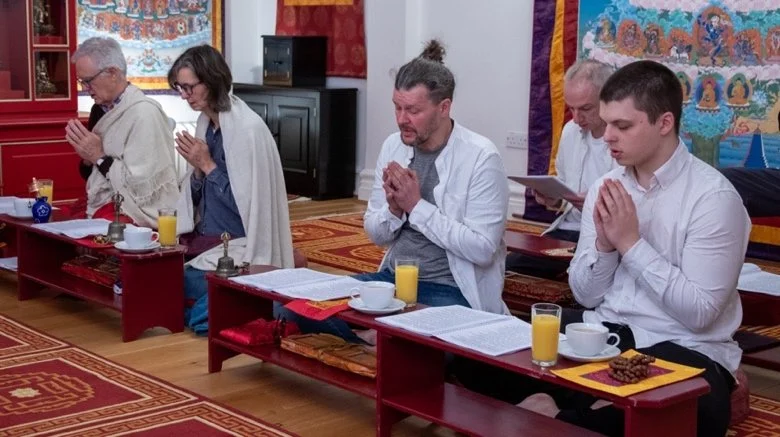
Writing this on the 17th Karmapa Thinley Thaye Dorje’s birthday, I am reminded of His Holiness’s instruction that we should approach everything we do with joy. And joy is what I feel when thinking about having the opportunity to spend time doing a nyungne retreat, even if the aspect of nyungne that seems to stick in most people’s minds is fasting! Nyungne can be translated as ‘abiding in the fast,’ so perhaps it is not surprising that this is what people remember about the practice. However, the joy of spending several days meditating on the 1000-armed form of the bodhisattva of compassion, Chenrezig, and all the benefits of that often seem to get overlooked. And because fasting is ultimately only a support that allows one to focus more completely on the practice, it is worth remembering that if fasting is difficult for someone, it is not an absolute requirement for participating in the practice.
I first received an empowerment of 1000-armed Chenrezig in the 1990s and more recently from Lama Jampa. The aspects of the nyungne practice associated with 1000-armed Chenrezig that attracted me from when I first received the empowerment are the focus on compassion and the opportunity to spend time in retreat with others with that same focus. I’m not sure that I even realised that fasting was involved, and had I known this perhaps I wouldn’t have been so keen to sign up when nyungne was first available at Kagyu Ling!
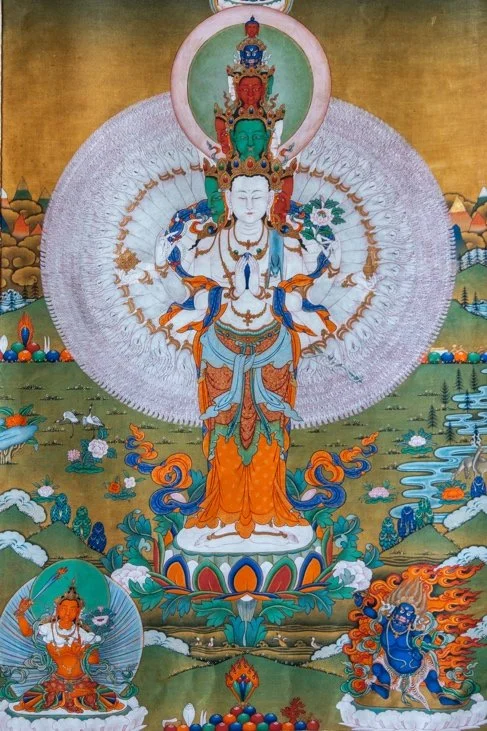
1000-armed Chenrezig
Another important aspect of the nyungne practised at Kagyu Ling is the connection that it provides with our lineage. The annual retreat at Kagyu Ling continues a tradition that was started in Nangchen by Karma Thinley Rinpoche’s uncle, Pön Namkai Dorje, who was the head of the Bongsar clan of Nangchen in Kham. He met His Holiness the 16th Karmapa when His Holiness was touring Kham in the early 1950s, and Namkai Dorje subsequently converted a large part of the Bongsar clan’s palace into a monastery, making the main hall a nyungne temple with a 2-storey 1000-armed Chenrezig statue. When Rinpoche was young, nyungne was practised at this temple by hundreds of people from the Bongsar estates twice yearly, during Saga Dawa and during the first half of the ninth Tibetan month, which includes Lhabab Duchen. Both sessions of nyungne were sponsored by Namkai Dorje. The tradition was continued after Namkai Dorje and the Bongsar clan fled Tibet in 1959, and was eventually established at Rinpoche’s gompa, Thegchen Legshay Ling, in Nepal, again sponsored by Namkai Dorje and, since his death, by his daughter Sremo Tsodi. This tradition is now being continued at Kagyu Ling in Manchester.
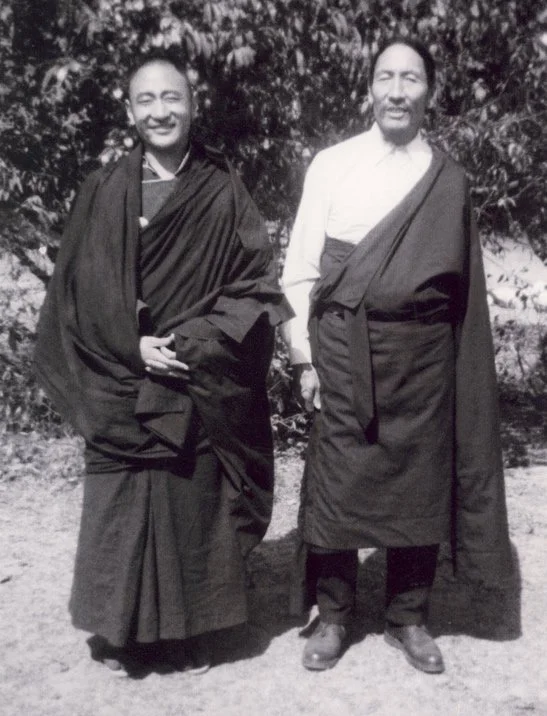
Karma Thinley Rinpoche and Pön Namkai Dorje in India in the 1960s
The fact that we are able to practice nyungne has been made possible through the blessings of the lamas and the efforts of Kunga Gyaltsen, Barbara Franzel and Jonathan Macaskill. Kunga and Barbara lead the nyungne, teaching all who participate the sadhana practice, the associated prayers and rituals, preparing the shrine, and generally ensuring that everything is done correctly. Jonathan coordinates the logistics of the retreat, promotes the nyungne, ensure everyone knows what they need, where they need to be and when, and (very importantly!) wakes everyone up at 5 am for the first session of the day. The support of the Kagyu Ling community also cannot be over-emphasised; without the large group of people, led by Gill Bennett initially and more recently by Christine Dicken, who volunteer to cook, clean, serve food and refreshments, etc to ensure that the retreatants can focus on practice, the nyungne, could not happen. Rinpoche says that those supporting nyungne accumulate at least as much merit as those doing the actual retreat.
Over the years, I have been fortunate to be able to do several single 2-day nyungne to develop some familiarity with the practice, to build on that by doing two nyungne back to back, and for the past 2 years have done all three of the nyungne that are held at Kagyu Ling. As Kunga said during his introduction to the practice ‘[All who participate] have shared karma, links with Chenrezig in past lives or this life, and links with our gurus; all these circumstances and our bodhisattva wishes have brought us together in this wonderful nyungne practice.’
So, what is involved? Each day starts at 5.30 am with recitation of Jamgon Kongtrul Lodro Thaye’s prayer Devotion That Moves The Heart. A Prayer Calling the Lama From Afar. This beautiful prayer is chanted using a tune that is specific to our lineage. For me, the sense of deep longing and devotion to the lama invoked by the tune fits perfectly with the words, which request our lamas support and blessings for our practice. This is followed by the Praise of the Twelve Deeds, which many of us know well.
Next, we recite The Sutra of the Three Heaps or 35 Buddhas Confession Prayer. Rinpoche, in his commentary on this sutra, The Excellent Vase of Nectar, says ‘The three heaps are the heap of confession, the heap of rejoicing, and the heap of dedication. The recitation of this profound sutra is said to be supreme method of confession.’ The sutra calls on the 35 buddhas to witness our confession of all negative actions and our resolve not to repeat them. Recitation of the confession in English serves to emphasise the confession. Having invoked Buddha Shakyamuni, taken refuge and confessed our misdeeds, we are now ready to take the Sojong vows, which follow.
Maintaining the Sojong vows and our Mahayana and Vajrayana vows perfectly, combined with practising the sadhana perfectly, ensures that our karmic connection with Chenrezig is strengthened. The vows are 8-fold and add not using high seats, giving up food at improper times and not wearing jewellery and not singing or dancing to the five pratimoksha vows, which in this case are not those of a lay person but of one who is ordained. That is, no sexual misconduct is increased to celibacy, no intoxication is upgraded to no intoxicants, no stealing has the added feature of not taking things that do not belong to you, etc. An ordained person takes these vows for life, in Sojong they last for one day, from dawn to dawn.
For me, the sojong vows create a foundation for the retreat: while I am not constantly worrying about whether I am breaking one of the vows, the vows allow me to assess my actions to determine whether they are within the spirit of the practice and adapt accordingly. Of course, a nyungne retreat is a controlled environment, which makes keeping vows easy.
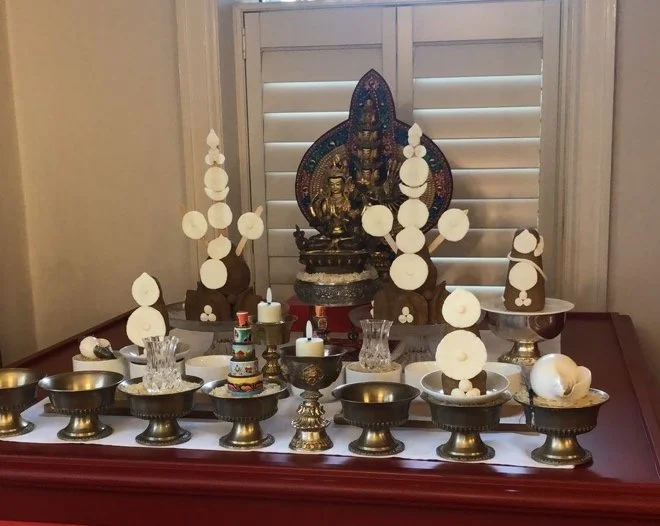
Shrine for the nyungne
Then, we move to the sadhana. The sadhana that we use for the practice of nyungne at Kagyu Ling is not one that is commonly used. It was composed by Karma Chagme, the teacher of tertön Namchö Mingyur Dorje from whose Sky Dharma treasures Lama Jampa frequently teaches. However, the sadhana should be viewed as coming directly from Chenrezig to maximise its benefit and power. This is the sadhana that was used in the Bongsar palace in Nangchen. It is inspiring to know that the particular tunes used are also the same and that some come from Rinpoche’s great uncle, the famous yogi Jamyang Temphel, who was a disciple of Dza Patrul Rinpoche and Jamgon Kongtrul Lodro Thaye. These close connections to great masters serve to emphasise the power of the practice.
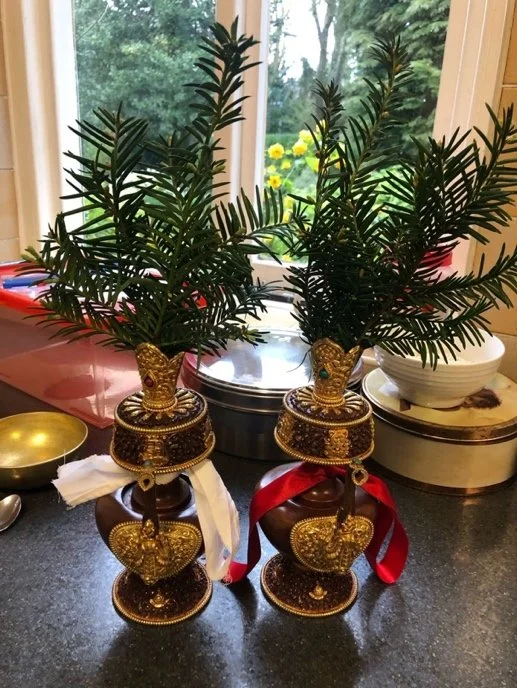
Bumpas used during the nyungne
The sadhana guides us through a series of visualisations of Chenrezig, accumulation of merit and wisdom, and receipt of blessings from the five dhyani Buddhas and Chenrezig that naturally result in us expressing the enlightened activity (thinley) of Chenrezig – compassion. Thus, through mantra recitation, we focus on the natural expression of compassion for all beings. In nyungne, we recite three mantras. First, we recite a long dharani, which has a unique element, because Rinpoche has updated it to refer to purifying negativities, faults and obscurations rather than leprosy. The original reference to leprosy comes from Gelongma Palmo, from whom the practice of nyungne originates and who practiced nyungne for many years and was thus cured of leprosy. Second, we recite a medium length mantra, a subsection of the dharani. Third, we recite the 6-syllable mantra of Chenrezig. Two sessions of mantra recitation are done with different visualisations.
The blessings of Chenrezig, requested with the aim of moving us nearer to liberating all beings, are received while reciting the famous Po To prayer while prostrating. This prayer, written by Gelongma Palmo herself, poetically describes the attributes of Chenrezig and requests his blessings, and fittingly is recited to a beautiful tune. The session of practice ends with a series of offerings, dedications and aspiration prayers.
Where does the fasting come in? Nyungne is practised over 2 days, finishing on the morning of the third day. Throughout the first day and until one goes to bed, one can drink. One of the requirements of the sojong vows is to not take that which is not given, which means that one can only eat and drink food and liquid that is offered. While I found this challenging to start with, it removes the tendency to focus on where the next meal is coming from! However, only lunch is eaten on this day, served at about 12.30. The day starts at 5.30 am but the period until lunch is so focused on practice, with two sessions of the sadhana completed in this time, that time passes quickly. Between sessions, there is the opportunity to read, circumambulate Kagyu Ling and the stupa, and rest. The next meal is taken early on the morning of the third day, when the fast is broken. Therefore, each 2-day set comprises:
3 sessions of practice on Day 1, starting at 5.30 am, with lunch at 12 or 12.30 pm and no other meals, and being able to drink until retiring for the night
3 longer sessions of practice on Day 2, also starting at 5.30 am, but with no food or fluids and keeping silent
1 session on Day 3, again starting at 5.30 am. This is also the start of the next 2-day set, so retreatants joining for the next set arrive at Kagyu Ling before it begins. During this session, those retreatants who are finishing the 2-day set receive soup to break their fast. The soup is given before the sojong vows are taken so that the vows can be kept properly during the next 2-day set.
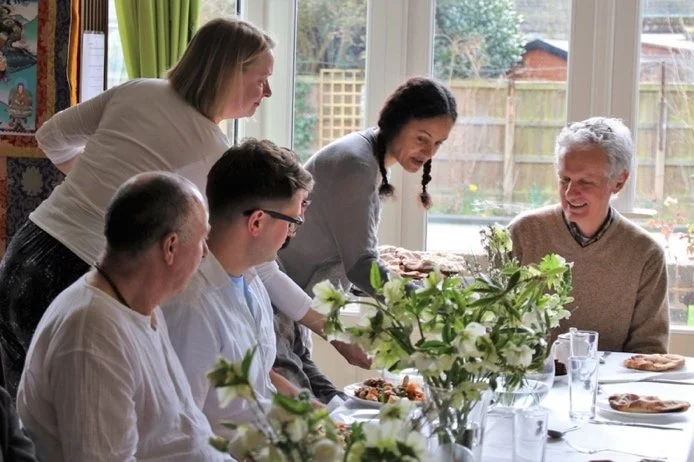
Lunch being served to retreatants on the first day of the nyungne
So, what are my recollections of practicing nyungne?
The support provided by Kunga and Barbara, both in terms of ensuring that we understand the practice and the role of fasting, etc but also in terms of emotional support, makes what could be a daunting experience much easier.
The practice is beautiful – the tunes used for the various prayers seem to focus my mind and foster the connection with Chenrezig.
Practising as much as we do during the retreat means that the flow of the practice becomes natural, allowing the mind to develop the visualisations and the sense of compassion to arise.
Doing more than one nyungne means that my mind becomes more and more relaxed and spacious.
Being in retreat with others while we are all carefully observing the vows is incredibly supportive of the practice
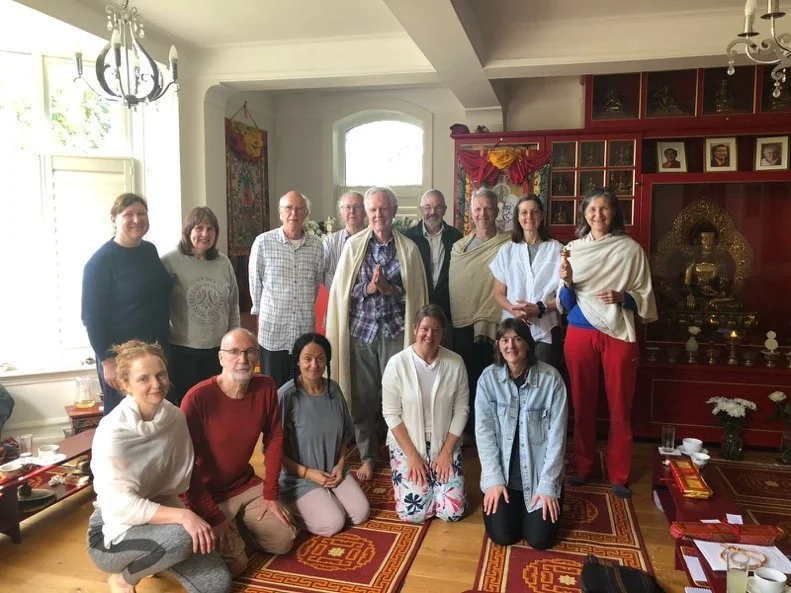
Group of retreatants at the close of the nyungne
Kagyu Ling is a wonderful place in which to practice nyungne – the shrine room is such a powerful space and walking mindfully in the peaceful gardens between sessions, particularly now that the stupa has been installed, reciting mantras and maintaining the visualisation of Chenrezig is a joy.
Fasting, or not having to think about obtaining or preparing food, is less of a problem than one might think. I may experience hunger or thirst but it is never overwhelming.
The strong sense of compassion for all beings that is developed extends beyond the time of the retreat, strengthening my daily practice.
I would encourage everyone to seriously consider doing nyungne at least once – it is a practice with so many benefits!
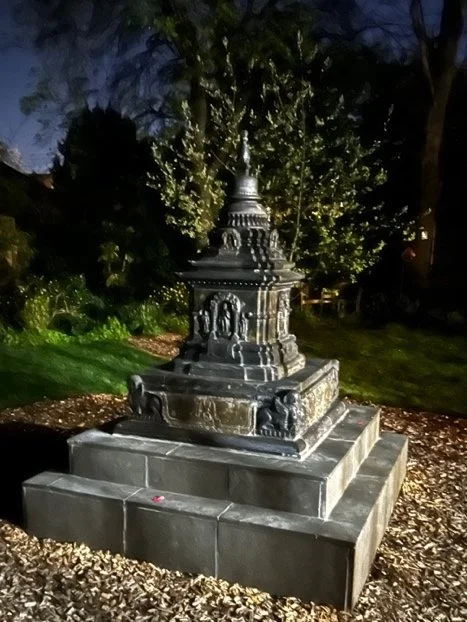
Kagyu Ling Stupa
Photos courtesy of Kunga Gyaltsen, Gill Bennett and Andy Noble
